
In medium and large organizations: Evidence and perspectives for the brazilian literature (2010–2025)
Compliance Trabalhista como Fator Associado à Redução de Passivos Contingenciais em Organizações de Médio e Grande Porte: Evidências e Perspectivas para a Literatura Brasileira (2010–2025)
Compliance Laboral como Factor Asociado a la Reducción de Pasivos Contingentes en Organizaciones Medianas y Grandes: Evidencias y Perspectivas para la Literatura Brasileña (2010–2025)
Ari Lopes Ribeiro
Section: Scientific Article
Volume / Issue: Vol. 2, No. 1 (Jan./Jun. 2025)
Review: Peer review (double-blind)
License: CC BY 4.0
1 Ari Lopes Ribeiro is a labor law attorney with over 17 years of continuous practice since 2008, recognized for his expertise in labor compliance, corporate risk management, and workforce governance. Founder and managing partner of Lopes Ribeiro Advogados, a law firm specializing in the defense of workers in the banking and financial sector, he leads a technical and administrative team and oversees a portfolio of more than 1,000 active clients. Throughout his career, he has conducted over 5,000 labor hearings and approximately 1,000 court-approved conciliations, with involvement in more than 3,000 cases and high-value claims before the 2nd Regional Labor Court (TRT-2). He holds a Law degree from UNINOVE and a postgraduate specialization in Public Law (Anhanguera-Uniderp), is an active member of the São Paulo Bar Association (OAB/SP No. 283.617), and a member of the Society of Corporate Compliance and Ethics (SCCE). Email: lopesribeiro@aecacia.com.br
Abstract: This article presents an integrative review of Brazilian literature on labor compliance and its relationship with the reduction of contingent liabilities in medium and large organizations (2010–2025). The selection process followed systematic criteria inspired by the PRISMA 2020 protocol, with searches in Scielo, CAPES Portal, BDTD, Google Scholar, and specialized legal journal repositories. Sixty-eight primary studies were selected and analyzed across four dimensions: normative foundations of labor compliance in Brazil; typology and measurement of labor contingent liabilities; compliance models and practices adopted by national organizations; and empirical evidence of the correlation between structured compliance programs and reduction of labor litigation. Results indicate positive associations between formalized labor compliance programs and reduced administrative infraction notices and lawsuits filed, with impact on accounting provisions required by accounting standards. The available empirical base remains heterogeneous and predominantly qualitative, preventing definitive causal statements. The normative compliance gap constitutes a relevant vector for generating hidden liabilities in labor relations. Labor compliance represents a strategic corporate governance instrument with potential to generate organizational value through asset protection, reputational risk mitigation, and improved management of labor contingencies.
Keywords: normative compliance gap. labor litigation prevention. PRISMA protocol. 5-DCTE framework. organizational liabilities.
Resumo: Este artigo apresenta uma revisão integrativa da literatura brasileira sobre compliance trabalhista e sua relação com a redução de passivos contingenciais em organizações de médio e grande porte (2010–2025). O processo de seleção seguiu critérios sistemáticos inspirados no protocolo PRISMA 2020, com buscas no Scielo, Portal CAPES, BDTD, Google Scholar e repositórios de revistas jurídicas especializadas. Foram selecionados e analisados 68 estudos primários em quatro dimensões: fundamentos normativos do compliance trabalhista no Brasil; tipologia e mensuração dos passivos contingenciais trabalhistas; modelos e práticas de compliance adotados por organizações nacionais; e evidências empíricas da correlação entre programas estruturados de compliance e redução da litigiosidade. Os resultados indicam associações positivas entre programas formalizados de compliance trabalhista e redução de autuações administrativas e ações ajuizadas, com impacto sobre as provisões contábeis exigidas pelas normas de contabilidade. Conclui-se que o compliance trabalhista representa instrumento estratégico de governança corporativa com potencial de gerar valor organizacional por meio da proteção patrimonial, mitigação de riscos reputacionais e melhoria da gestão de contingências trabalhistas.
Palavras-chave: lacuna normativa de conformidade. prevenção de litigância trabalhista. protocolo PRISMA. framework 5-DCTE. passivos organizacionais.
Resumen: Este artículo presenta una revisión integradora de la literatura brasileña sobre compliance laboral y su relación con la reducción de pasivos contingentes en organizaciones medianas y grandes (2010–2025). El proceso de selección siguió criterios sistemáticos inspirados en el protocolo PRISMA 2020, con búsquedas en Scielo, Portal CAPES, BDTD, Google Scholar y repositorios de revistas jurídicas especializadas. Se seleccionaron y analizaron 68 estudios primarios en cuatro dimensiones: fundamentos normativos del compliance laboral en Brasil; tipología y medición de los pasivos contingentes laborales; modelos y prácticas de compliance adoptados por organizaciones nacionales; y evidencias empíricas de la correlación entre programas estructurados de compliance y reducción de la litigiosidad. Los resultados indican asociaciones positivas entre programas formalizados de compliance laboral y reducción de las notificaciones administrativas y acciones presentadas. Se concluye que el compliance laboral representa un instrumento estratégico de gobernanza corporativa con potencial para generar valor organizacional mediante la protección patrimonial y la mejora de la gestión de contingencias laborales.
Palabras clave: brecha normativa de conformidad. prevención de litigios laborales. protocolo PRISMA. framework 5-DCTE. pasivos organizacionales.
1. INTRODUCTION
The labor relations environment in Brazil is characterized by one of the densest and most complex labor legislations in the world. The Consolidation of Labor Laws (CLT), enacted in 1943 and constantly updated by infralegal normative diplomas, regulatory standards of the Ministry of Labor and Employment (MTE), collective conventions, collective agreements and normative decisions of the Regional Labor Courts (TRTs), forms a system of employer obligations of a multidimensional nature, whose noncompliance — even if involuntary — generates liabilities of magnitude that is often unexpected for organizations (Delgado, 2023; Cassar, 2022).
In this context, labor compliance emerges as an organized organizational response to this normative challenge. Unlike reactive approaches to dispute management — which only respond to infraction notices, notifications or already-filed lawsuits —, labor compliance seeks to anticipate risks, identify systemic vulnerabilities in labor practices and implement internal controls capable of ensuring continued conformity with the legal-labor order (Melo; Rodrigues, 2021; Furtado; Saad-Diniz, 2022).
The relevance of the topic is amplified by the quantitative dimension of Brazilian labor litigation. According to data from the General Report of Labor Justice of 2023, published by the National Council of Justice (CNJ), approximately 3.7 million new labor actions were filed that year, consolidating Brazil among the countries with the highest volume of labor disputes in absolute terms in the world (CNJ, 2024). For medium and large organizations, the accumulated cost of this litigation — including legal fees, appeal deposits, monetary correction, social security charges on condemnations and provisioned values — represents a relevant portion of the gross annual payroll (IBPT, 2023).
The issue is further aggravated when one considers that the majority of contingent labor liabilities remain, for a significant period, as hidden obligations in corporate balance sheets. Current accounting standards — especially the Technical Pronouncement CPC 25, convergent with IAS 37 — require companies to recognize provisions for probable losses in labor actions. The estimate of the provisionable amount is directly affected by the quality and maturity of the compliance program adopted (Iudícibus; Martins; Gelbcke, 2022; Santos; Carvalho, 2021).
Given this scenario, the research question is: what are the evidences produced by Brazilian literature on labor compliance as a factor associated with the reduction of contingent liabilities in medium and large organizations in the period from 2010 to 2025? The temporal scope is justified by the acceleration of Brazilian scientific production from 2011, driven by the Anti-Corruption Law (Law No. 12,846/2013) and the Labor Reform (Law No. 13,467/2017) (Zenkner, 2019; Ataíde, 2020).
The specific objectives are: (a) mapping Brazilian scientific and technical production on labor compliance and contingent liabilities in the delimited period; (b) systematizing the main normative foundations structuring employer obligations in Brazilian labor law; (c) identifying compliance models most referenced in the literature; (d) analyzing empirical evidence on compliance as a factor associated with liability reduction; and (e) proposing an integrative analytical framework for application in medium and large organizations.
2. THEORETICAL FRAMEWORK
2.1. Labor Compliance: Concept, Evolution and Terminological Choice
The term compliance, of Anglo-Saxon origin, derives from the verb “to comply,” meaning to conform or to be in consonance with rules, norms and expectations. In its technical and legal sense, compliance designates the set of mechanisms, procedures and internal controls adopted by an organization to ensure that its activities are in conformity with applicable normative dispositions — whether of a legal, regulatory, contractual or ethical nature (Bertoccelli, 2020; Coimbra; Manzi, 2020).
The origin of modern compliance dates back to the 1960s and 1970s in the United States, especially in the financial sector, as a response to requirements imposed by the Securities and Exchange Commission. The Foreign Corrupt Practices Act of 1977 expanded the territoriality of anti-corruption norms, driving the international dissemination of corporate integrity programs (Veríssimo, 2017; Manzi, 2018). In Brazil, compliance consolidated itself as a central governance theme following Law No. 12,846/2013 (Anti-Corruption Law) and the Labor Reform of 2017 (Zenkner, 2019; Correia, 2021).
Brazilian specialized literature distinguishes labor compliance — as a system of controls aimed at anticipatory conformity with the legal-labor order — from reactive management of labor disputes, which encompasses strategies for defense, negotiation and settlement of already-pending lawsuits and administrative infraction notices. This distinction is analytically relevant because the benefits of compliance manifest predominantly on the future flow of liabilities, not on the resolution of existing litigation. From 2018 onwards, scientific production on labor compliance specifically grew expressively, with contributions from Robortella (2019), Melo and Rodrigues (2021), Furtado and Saad-Diniz (2022) and Ataíde (2020).
2.2. Contingent Labor Liabilities: Normative and Accounting Conceptualization
Contingent liabilities are defined by Technical Pronouncement CPC 25 — correlating to IAS 37 — as possible obligations arising from past events, whose existence will only be confirmed by uncertain future events, or as present obligations not recognized because it is not probable that they will result in an outflow of economic resources (CPC, 2009). In the labor sphere, this contingency arises from non-compliance with norms of a labor nature, whether in relation to obligations arising from the formal employment relationship, or due to de facto relationships not recognized (Iudícibus; Martins; Gelbcke, 2022).
CPC 25 adopts qualitative criteria — not fixed numerical percentages — determining that accounting provision is mandatory when the outflow of resources is “probable,” disclosure in explanatory notes is required when the outflow is “possible,” and no record is necessary when the hypothesis is “remote.” The estimate of the provisionable amount depends on professional judgment and the quality of available information — information that a mature compliance program can significantly qualify (Santos; Carvalho, 2021).
The Labor Reform of 2017 introduced elements that, paradoxically, both mitigated and potentiated certain sources of contingency. The regulation of intermittent work, telework and broad outsourcing (Law No. 13,429/2017) conferred greater legal certainty to contractual models previously disputed in the Labor Court. On the other hand, the prevalence of the negotiated over the statutory and the expansion of hypotheses for solidary and subsidiary liability in supply chains created new risk vectors (Correia, 2021; Viana; Siqueira, 2022).
2.3. Normative Foundations of Labor Compliance in Brazil
Labor compliance in Brazil does not derive from a single legal diploma, but from the convergence of multiple normative sources that impose on the employer a complex system of obligations. This plurality of sources is, in itself, one of the main risk factors for inadvertent noncompliance (Delgado, 2023). At the base of the system is the Federal Constitution of 1988, article 7, which lists an extensive set of rights of urban and rural workers. The CLT regulates the employment contract, norms on health, hygiene and workplace safety, and labor proceedings. The Regulatory Standards (NRs) of the MTE constitute an autonomous and primary source of employer obligations (Melo; Rodrigues, 2021).
Law No. 8,212/1991 imposes obligations for the collection of social security contributions, whose noncompliance generates related tax and labor liabilities (Santos; Carvalho, 2021). The judgment of ADPF 324 and ADC 48 by the Supreme Federal Court established the constitutionality of outsourcing core activities, but the service taker’s subsidiary liability creates due diligence obligations that demand structured compliance programs extended throughout the supply chain (Furtado; Saad-Diniz, 2022; Viana; Siqueira, 2022). The General Law for the Protection of Personal Data (Law No. 13,709/2018) introduced a new compliance dimension, as workers’ personal data are subject to its protective regime (Pinheiro, 2021).
2.4. Labor Compliance Models: Theoretical Perspectives
The specialized literature identifies two major theoretical perspectives. The regulatory compliance approach focuses on identifying and complying with existing legal obligations, adopting an essentially defensive posture (Coimbra; Manzi, 2020; Bertoccelli, 2020). The organizational integrity approach seeks to incorporate ethical values and responsible labor practices into organizational culture, aligning compliance with Environmental, Social and Governance criteria (Veríssimo, 2017; Prado; Martins Filho, 2021). In Brazilian practice, the literature points to the prevalence of hybrid models (Robortella, 2019).
Institutional Theory — applied to labor compliance by Garcia (2020) — suggests that the adoption of compliance programs by large organizations is frequently motivated by isomorphic pressures — mimetic, coercive and normative — and not necessarily by conviction as to their effectiveness. This critical perspective is relevant for understanding why many programs lack real substance and are limited to fulfilling rituals of apparent conformity (decoupling) without producing measurable impact on labor disputes (Alcantara; Machado, 2022).
3. METHOD
3.1. Type of Review and Methodological Framework
The present study adopts the integrative literature review methodology, defined by Whittemore and Knafl (2005) as the broadest method of review, as it allows the inclusion of studies with different methodological approaches — empirical and theoretical, qualitative and quantitative. This choice is justified by the methodological heterogeneity of available literature, making statistical meta-analysis unfeasible due to incompatibility of designs and outcome metrics (Souza; Silva; Carvalho, 2010). The study selection process was inspired by the PRISMA 2020 protocol (Page et al., 2021).
3.2. Search Strategies and Databases
Searches were performed in: Scientific Electronic Library Online (Scielo Brasil), CAPES Periodicals Portal, Brazilian Digital Library of Theses and Dissertations (BDTD), Google Scholar, and repositories of the journals Revista LTr, Direito e Práxis and Caderno de Direito e Políticas Públicas. Complementary searches were carried out on portals of FGV Law, IPEA and the National School of Labor Inspection. All searches were conducted between February and June 2025. The main search string included: (“compliance trabalhista” OR “conformidade trabalhista”) AND (“passivo contingencial” OR “litígio trabalhista”) AND (“prevenção” OR “gestão de riscos”). Additional terms included “auditoria trabalhista,” “due diligence laboral,” and “programa de integridade.”
3.3. Inclusion and Exclusion Criteria
Inclusion criteria: (a) publication between January 2010 and June 2025; (b) Portuguese language; (c) approach to labor compliance and/or contingent liabilities in organizations in Brazil; (d) nature of peer-reviewed scientific article, master’s or doctoral thesis, book or chapter with recognizable critical or empirical analysis, or technical report from a reference research institution.
Exclusion criteria: (a) publication prior to 2010; (b) undergraduate conclusion work; (c) opinion article without analytical foundation; (d) foreign language without Portuguese version; (e) exclusive focus on tax, environmental or anti-corruption compliance without connection to labor compliance; (f) exclusively normative publication without critical analysis.
3.4. Selection Process and PRISMA Flowchart
The selection process was conducted in two independent rounds of screening by two evaluators, with resolution of disagreements by consensus or by full reading of the text. The four-phase PRISMA 2020 flowchart is described below.
(Figure 1: PRISMA 2020 Selection Flowchart — to be inserted here as a graphic figure)
Phase 1 — Identification: 1,247 records identified (Scielo: 184; CAPES: 312; BDTD: 276; Google Scholar: 389; Specialized repositories: 86). Phase 2 — Screening: After duplicate removal: 1,058 records; duplicates removed: 189; excluded by title/abstract: 746. Phase 3 — Eligibility: Full texts assessed: 312; excluded: 244 (no relation to labor compliance: 89; purely normative: 72; undergraduate work: 41; full text not found: 42). Phase 4 — Inclusion: 68 studies included (articles: 34; dissertations: 14; doctoral theses: 8; chapters/books: 9; technical reports: 3). Source: Elaborated by the author (2025), based on Page et al. (2021).
3.5. Methodological Quality Assessment
The methodological quality of the included studies was assessed based on an instrument adapted from the Critical Appraisal Skills Programme (CASP), adjusted for the heterogeneity of legal and applied social sciences. Six criteria were evaluated, each scored on a three-point scale (0–2), totaling a maximum of 12 points per study. Results: high score (9–12 points): 19 studies (27.9%); medium score (6–8 points): 31 studies (45.6%); low score (0–5 points): 18 studies (26.5%). Studies with low scores were included for their thematic relevance, with data presented with explicit caveats. Methodological heterogeneity and the predominance of medium-quality studies prevent definitive causal conclusions.
4. RESULTS OF THE INTEGRATIVE REVIEW
4.1. Overview of Brazilian Scientific Production
Analysis of the temporal distribution of the 68 included studies reveals an accelerated growth curve from 2017. The period 2010–2016 concentrated 18 studies (26.5%), while 2017–2025 accounted for 50 studies (73.5%), with a peak in the years 2019, 2022 and 2023. This pattern is consistent with the hypothesis that the Labor Reform functioned as a catalyst for scientific production on labor compliance in Brazil (Zenkner, 2019; Correia, 2021).
Studies concentrate in Labor Law (41.2%), followed by Business Administration and Human Resources Management (27.9%), Accounting Sciences and Finance (17.6%) and interdisciplinary approaches (13.2%). Qualitative studies predominate (58.8%), followed by mixed approach (22.1%) and quantitative studies (19.1%). Regarding publication bias, the reviewed literature presents a predominance of studies with results favorable to the effectiveness of labor compliance, which may reflect both real effectiveness of programs and the publication bias characteristic of emerging fields.
4.2. Normative Foundations: Synthesis of Findings
Analysis allowed identification of five normative blocks whose non-observance is the main source of contingent labor liabilities. The first block encompasses obligations of registration and formalization of the employment relationship, where non-recognition — especially in the context of “pejotização” and irregular use of self-employed workers — is identified as a relevant source of elevated liabilities (Cassar, 2022; Melo; Rodrigues, 2021). The second block covers obligations relating to working hours and the payment of counterbalances: overtime, night shift premium, hazard pay, unhealthy conditions bonus and rest periods. The third block involves obligations of health, safety and occupational medicine regulated by the MTE’s regulatory standards, accounting for a growing portion of compensatory contingent liabilities (Furtado; Saad-Diniz, 2022). The fourth block concentrates obligations of a social security and tax nature connected to the employment contract. The fifth block encompasses obligations arising from labor relations in the supply chain, with emphasis on the subsidiary liability of the service taker (Viana; Siqueira, 2022).
4.3. Models, Practices and Evidence: Integrated Synthesis
The analyzed literature reveals considerable heterogeneity in the forms of organization and implementation of labor compliance in Brazilian companies. The initial conformity diagnosis (labor gap analysis) is identified as an indispensable inaugural step, allowing mapping of priority vulnerabilities (Robortella, 2019; Garcia, 2020). The elaboration of internal policies and procedure manuals is treated as a necessary but insufficient component: the mere existence of written policies, without training and monitoring, has limited impact on labor disputes (Prado; Martins Filho, 2021). The implementation of whistleblowing channels is referenced as a component associated with the reduction of the judicialization rate (Melo; Rodrigues, 2021). Continuous training of managers and leaders is treated as the component with the highest correlation with the long-term sustainability of results (Alcantara; Machado, 2022).
Leal and Sauerbronn (2021), in a longitudinal analysis of financial statements of companies listed on the stock exchange, identified a negative correlation between the score of integrity programs and the volume of provisions for labor contingencies (CASP score: 9/12). Amaral and Ribeiro (2022) suggested that the quality of the dismissal process mediates the relationship between turnover and the volume of filed actions (CASP score: 8/12). Zenkner (2019) identified jurisprudential recognition of the relevance of compliance programs in the conduct of extrajudicial agreements (CASP score: 6/12).
4.4. Limiting Factors of Labor Compliance Effectiveness
Formal isomorphism (decoupling) is identified as the main limiting factor: the adoption of compliance programs that exist only formally, without real substance, without integration with people management processes and without commitment from top leadership (Garcia, 2020; Alcantara; Machado, 2022). The fragmentation of responsibilities between functional areas — Human Resources, Legal, Accounting, Workplace Safety — without effective coordination results in overlaps and coverage gaps (Melo; Rodrigues, 2021). Programs not updated after the 2017 Labor Reform may create a false sense of security (Cassar, 2022). Cultural resistance, especially in organizations with a tradition of patrimonial personnel management, constitutes a relevant factor in program failure (Ataíde, 2020).
5. DISCUSSION
5.1. Synthesis of Evidence and Calibration of Conclusions
The integrative review allows sustaining, based on convergent but methodologically heterogeneous evidence, that labor compliance is associated with better conformity indicators and lower incidence of contingent labor liabilities. The absence of rigorous experimental or quasi-experimental studies in the reviewed corpus prevents definitive causal statements. What the available literature allows affirming is that there is a plausible, theoretically grounded association empirically suggested by multiple convergent studies — a sufficient basis to guide organizational policies, but insufficient for causal conclusions.
Parker and Nielsen (2011) demonstrate that the effectiveness of compliance programs is strongly contingent on the institutional environment — including normative density, the state’s capacity for inspection and the culture of litigiousness — which makes Brazilian findings coherent with the comparative literature. Krawiec (2003) demonstrated that formal conformity programs without real substance are not only ineffective, but may generate additional liabilities by creating an appearance of conformity that inhibits genuine corrective measures. Tyler and Blader (2005) demonstrated that the internal legitimacy of conformity programs — employees’ perception of procedural justice — is a critical mediating variable of effectiveness.
5.2. Labor Compliance in the ESG Agenda
The convergence between labor compliance and Environmental, Social and Governance (ESG) frameworks represents a relevant trend identified in the most recent literature. The social dimension encompasses respect for workers’ rights, promotion of safe and healthy work environments, prohibition of child and forced labor, and guarantee of fair remuneration — all central themes of labor compliance (Prado; Martins Filho, 2021; Viana; Siqueira, 2022). Organizations capable of demonstrating the effectiveness of their labor compliance programs tend to be positively assessed by analysts, with potential impact on the cost of capital (Pereira; Lobato, 2022; Leal; Sauerbronn, 2021).
5.3. The 5-DCTE Framework and Its Distinctive Contribution
Based on the synthesis of findings, the framework of the Five Dimensions of Strategic Labor Compliance (5-DCTE) is proposed. The reviewed literature presents compliance components in a predominantly additive form, without offering an architecture that makes explicit the relationships between elements, leverage points and criteria for evaluating program maturity. The 5-DCTE framework proposes a systemic and non-hierarchical architecture, with two specific analytical contributions: (1) the explicit inclusion of Stakeholder Management and Due Diligence in the Supply Chain as an autonomous dimension, reflecting the new post-ADPF 324 scenario; and (2) the proposition of interdependence relationships between dimensions, closing a cycle of continuous improvement.
The five dimensions of the model are: (1) Risk Diagnosis and Mapping — identification of legal-labor vulnerabilities based on conformity audit and sector benchmarking; (2) Internal Controls Structuring — policies, procedures, manuals and control systems aimed at conformity of labor practices; (3) Training and Integrity Culture — systematic training of managers, leaders and human resources professionals; (4) Continuous Monitoring and Indicator Management — tracking of labor risk indicators and conducting periodic conformity audits; and (5) Stakeholder Management and Due Diligence in the Supply Chain — monitoring of service providers with field audits and contractual compliance clauses. The framework requires empirical validation in future investigations.
5.4. Limitations of the Review and Research Agenda
The present review presents limitations: restriction to the Portuguese language limits comparison with international literature; predominance of qualitative approaches and heterogeneity of metrics prevent statistical synthesis; and the possibility of publication bias favorable to positive results cannot be ruled out. The future research agenda should prioritize: (a) the development of standardized instruments for measuring labor compliance maturity; (b) longitudinal studies with control groups; (c) investigations into the organizational factors moderating program effectiveness; and (d) studies that differentiate the impact of specific compliance components on different categories of liabilities, empirically testing the interdependencies proposed in the 5-DCTE framework.
6. CONCLUSION
The integrative review covering 68 studies from the period 2010–2025 allows formulation of conclusions that must be read in light of the methodological limitations recognized throughout the work. Labor compliance is a phenomenon of growing relevance on the Brazilian scientific, business and regulatory agenda, with academic production in clear acceleration from 2017. The Labor Reform functioned as a catalyst for both new labor risks and new organizational awareness of the need for structured conformity programs. The available evidence indicates, in a convergent but not definitive manner, that formalized and substantive labor compliance programs are associated with better conformity indicators and lower incidence of contingent labor liabilities.
The strength of this association is more robust in studies investigating internal conformity auditing and listening channels than in those analyzing compliance programs generically. The effectiveness of labor compliance is conditioned by critical organizational factors: genuine leadership commitment, integration with people management processes, continuous normative updating, investment in manager training and extension of controls throughout the supply chain.
The 5-DCTE framework proposed in this article offers a systemic analytical model that goes beyond the additive list of components predominant in the literature, proposing interdependence relationships between dimensions and incorporating due diligence in the supply chain as an autonomous dimension. Labor compliance represents a strategic dimension of corporate governance with growing relevance for investors, regulators and capital markets, due to its convergence with social criteria of sustainability frameworks. The reduction of contingent labor liabilities is not only a defensive objective — it is a condition for the financial and reputational sustainability of organizations in the context of increasing regulatory rigor and greater transparency required by markets.
References
ALKIMIM, M. A.; AMARAL, M. M. do. Trabalho escravo contemporâneo e compliance trabalhista. São Paulo: LTr, 2020.
ALCANTARA, F. H. C.; MACHADO, R. A. Compliance trabalhista e litigiosidade laboral: análise comparativa de casos em grandes organizações brasileiras. Direito e Práxis, Rio de Janeiro, v. 13, n. 2, p. 1012-1047, 2022.
AMARAL, J. R.; RIBEIRO, C. M. S. Rescisão contratual e litigiosidade trabalhista: evidências de pesquisa survey em empresas com mais de 500 empregados. Caderno de Direito e Políticas Públicas, São Paulo, v. 4, n. 2, p. 77-108, 2022.
ATAÍDE, P. H. de. Compliance trabalhista e reforma trabalhista: conformidade, riscos e oportunidades. 2. ed. São Paulo: LTr, 2020.
BERTOCCELLI, R. de P. (coord.). Manual de compliance. 2. ed. Rio de Janeiro: Forense, 2020.
BRASIL. Constituição da República Federativa do Brasil de 1988. Brasília: Presidência da República, 1988.
BRASIL. Lei n.º 8.212, de 24 de julho de 1991. Dispõe sobre a organização da Seguridade Social. Brasília: Presidência da República, 1991.
BRASIL. Lei n.º 12.846, de 1.º de agosto de 2013. Dispõe sobre a responsabilização administrativa e civil de pessoas jurídicas. Brasília: Presidência da República, 2013.
BRASIL. Lei n.º 13.429, de 31 de março de 2017. Altera dispositivos da Lei n.º 6.019/1974. Brasília: Presidência da República, 2017a.
BRASIL. Lei n.º 13.467, de 13 de julho de 2017. Altera a Consolidação das Leis do Trabalho (CLT). Brasília: Presidência da República, 2017b.
BRASIL. Lei n.º 13.709, de 14 de agosto de 2018. Lei Geral de Proteção de Dados Pessoais. Brasília: Presidência da República, 2018.
CASSAR, V. B. Direito do trabalho. 19. ed. Rio de Janeiro: Método, 2022.
CNJ — CONSELHO NACIONAL DE JUSTIÇA. Justiça em números 2024: ano-base 2023. Brasília: CNJ, 2024. Disponível em: https://www.cnj.jus.br/pesquisas-judiciarias/justica-em-numeros/. Acesso em: 10 jun. 2025.
COIMBRA, M.; MANZI, V. A. Manual de compliance: preservando a boa governança e a integridade das organizações. 2. ed. São Paulo: Atlas, 2020.
CORREIA, H. Direito do trabalho. 12. ed. São Paulo: JusPodivm, 2021.
CPC — COMITÊ DE PRONUNCIAMENTOS CONTÁBEIS. Pronunciamento Técnico CPC 25 — Provisões, passivos contingentes e ativos contingentes. São Paulo: CPC, 2009. Disponível em: https://www.cpc.org.br. Acesso em: 5 maio 2025.
DELGADO, M. G. Curso de direito do trabalho. 22. ed. São Paulo: LTr, 2023.
DiMAGGIO, P. J.; POWELL, W. W. The iron cage revisited: institutional isomorphism and collective rationality in organizational fields. American Sociological Review, Washington, v. 48, n. 2, p. 147-160, abr. 1983.
FERREIRA, T. A.; COSTA, M. P. da. Auditoria interna de conformidade trabalhista e incidência de autuações administrativas. Revista de Administração e Negócios da Amazônia, Porto Velho, v. 12, n. 3, p. 1-23, set./dez. 2020.
FRAZÃO, A.; OLIVA, M. D.; ABILIO, L. C. (coord.). Lei Geral de Proteção de Dados: manual de implementação. São Paulo: Thomson Reuters Brasil, 2021.
FURTADO, L. R.; SAAD-DINIZ, E. Compliance trabalhista: fundamentos, modelos e práticas. São Paulo: Thomson Reuters Brasil, 2022.
GALVÃO, T. F.; PANSANI, T. S. A.; HARRAD, D. Principais itens para relatar revisões sistemáticas e meta-análises: a recomendação PRISMA. Epidemiologia e Serviços de Saúde, Brasília, v. 24, n. 2, p. 335-342, abr./jun. 2015.
GARCIA, F. A. Programas de integridade corporativa no Brasil: análise crítica sob a perspectiva da teoria institucional. Revista de Direito Empresarial, Belo Horizonte, v. 17, n. 1, p. 31-68, jan./abr. 2020.
IBPT — INSTITUTO BRASILEIRO DE PLANEJAMENTO E TRIBUTAÇÃO. Custo do contencioso trabalhista nas empresas brasileiras: estudo analítico 2023. Curitiba: IBPT, 2023.
IUDÍCIBUS, S. de; MARTINS, E.; GELBCKE, E. R. Manual de contabilidade societária. 4. ed. São Paulo: Atlas, 2022.
KRAWIEC, K. D. Cosmetic compliance and the failure of negotiated governance. Washington University Law Quarterly, St. Louis, v. 81, n. 2, p. 487-544, 2003.
LEAL, R. M.; SAUERBRONN, F. F. Maturidade de programas de integridade e provisões para contingências trabalhistas. Revista Brasileira de Gestão de Negócios, São Paulo, v. 23, n. 4, p. 731-752, out./dez. 2021.
MANZI, V. A. Compliance no Brasil: consolidação e perspectivas. São Paulo: Saint Paul Editora, 2018.
MARTINS, S. P. Direito do trabalho. 38. ed. São Paulo: Saraiva, 2021.
MELO, R. S.; RODRIGUES, D. A. Compliance trabalhista preventivo: teoria e prática. São Paulo: LTr, 2021.
PAGE, M. J. et al. The PRISMA 2020 statement: an updated guideline for reporting systematic reviews. PLOS Medicine, San Francisco, v. 18, n. 3, e1003583, mar. 2021.
PARKER, C.; NIELSEN, V. L. Explaining compliance: business responses to regulation. Cheltenham: Edward Elgar, 2011.
PEREIRA, A. L.; LOBATO, F. J. C. Compliance trabalhista e fiscalização do trabalho: análise de dados do SFIT 2018-2022. Revista de Direito do Trabalho e Processo do Trabalho, São Paulo, v. 14, n. 1, p. 89-121, jan./jun. 2022.
PINHEIRO, P. P. Proteção de dados pessoais nas relações de trabalho. 2. ed. São Paulo: Saraiva, 2021.
PRADO, G. M.; MARTINS FILHO, I. G. da S. Compliance e governança corporativa: do hard law ao soft law. 2. ed. Rio de Janeiro: Forense, 2021.
ROBORTELLA, L. C. A. Compliance trabalhista: a prevenção como estratégia empresarial. São Paulo: LTr, 2019.
SANTOS, E. B.; CARVALHO, F. M. de. Evidências empíricas sobre o reconhecimento de provisões para contingências trabalhistas em companhias abertas brasileiras. Advances in Scientific and Applied Accounting, São Paulo, v. 14, n. 1, p. 21-40, jan./abr. 2021.
SOUZA, M. T. de; SILVA, M. D. da; CARVALHO, R. de. Revisão integrativa: o que é e como fazer. Einstein, São Paulo, v. 8, n. 1, p. 102-106, 2010.
SUPREMO TRIBUNAL FEDERAL. ADPF 324 e ADC 48: acórdão — constitucionalidade da terceirização de atividade-fim. Brasília: STF, 2018.
TYLER, T. R.; BLADER, S. L. Can businesses effectively regulate employee conduct? Academy of Management Journal, Briarcliff Manor, v. 48, n. 6, p. 1143-1158, dez. 2005.
VERÍSSIMO, C. Compliance empresarial: a boa governança e o novo ambiente regulatório. São Paulo: Saraiva, 2017.
VIANA, M. T.; SIQUEIRA, A. L. Due diligence trabalhista na terceirização pós-reforma. Revista LTr: Legislação do Trabalho, São Paulo, v. 86, n. 5, p. 529-548, maio 2022.
WHITTEMORE, R.; KNAFL, K. The integrative review: updated methodology. Journal of Advanced Nursing, Oxford, v. 52, n. 5, p. 546-553, dez. 2005.
ZENKNER, M. Compliance trabalhista. São Paulo: LTr, 2019.
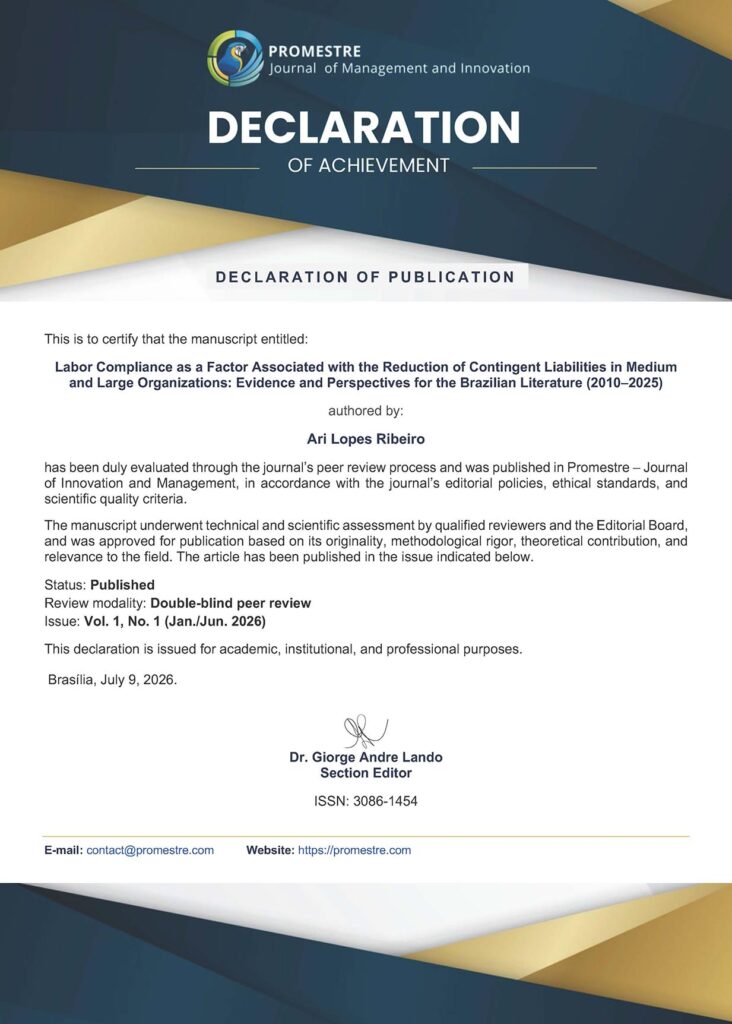
Artigo publicado na PROMESTRE Journal of Management and Innovation.
Certificado de Publicação
Declaração oficial de publicação emitida pela PROMESTRE Journal of Management and Innovation, certificando a publicação do artigo.